





Top 10 bidirectional battery inverter Manufacturers and Supplier Brands
- Top 10 manufacturers: brand profiles, strengths and selection guidance
- 1. Sungrow
- 2. Huawei
- 3. SMA
- 4. SolarEdge
- 5. GoodWe
- 6. Fronius
- 7. Victron Energy
- 8. Schneider Electric
- 9. Delta Electronics
- 10. OutBack Power
- Why professional sourcing (Congsin) is a smart choice for mid-to-large projects
- Buyer FAQs — common procurement questions
Buyers searching for a dependable bidirectional battery inverter need clear comparisons on reliability, round-trip efficiency, grid compliance, warranties, and OEM flexibility. This guide ranks 10 globally recognized manufacturers, compares headquarters, core expertise, and flagship bidirectional models, and explains where professional sourcing (vs brand High Quality) makes sense for medium-to-large deployments.
| Manufacturer | Headquarters Location | Key Expertise | Flagship Bidirectional Model |
|---|---|---|---|
| Sungrow | Yancheng, China | Utility-scale & residential hybrid inverters, energy storage systems | Sungrow ST (energy storage) series / SH (hybrid) |
| Huawei | Shenzhen, China | Smart PV inverters, integrated energy management, grid-comms | FusionSolar (SUN2000-ES) hybrid converters |
| SMA | Niestetal, Germany | Grid-tied/hybrid inverters, system integration for storage | Sunny Boy Storage / Sunny Tripower Storage |
| SolarEdge | Herzliya, Israel | DC-optimized inverters & energy hub with battery management | Energy Hub Inverter (StorEdge capable) |
| GoodWe | Jiangsu, China | Residential & commercial hybrid/storage inverters | GoodWe ES / ET series |
| Fronius | Pettenbach, Austria | High-quality residential/commercial inverters & backup systems | Symo Hybrid |
| Victron Energy | Groningen, Netherlands | Off-grid and hybrid inverter-chargers, advanced BMS compatibility | MultiPlus-II / Quattro (inverter-charger) |
| Schneider Electric | Rueil-Malmaison, France | Integrated energy management, residential & commercial storage | Conext XW+ / residential storage solutions |
| Delta Electronics | Taipei, Taiwan | Power electronics, industrial & utility storage inverters | Delta Energy Storage Inverter series |
| OutBack Power | Yulee, Florida, USA | Rugged off-grid and grid-interactive inverter-chargers | Radian Series (MX/GX) inverter-chargers |
Top 10 manufacturers: brand profiles, strengths and selection guidance
Below are concise but practical brand profiles focused specifically on bidirectional battery inverter capability, system integration and use cases—what technical decision-makers need to know for procurement.
1. Sungrow
Sungrow is widely recognized for a broad portfolio that spans utility-scale and residential energy storage inverters. Its ST and SH series are designed for DC‑coupled and AC‑coupled storage topologies with high round‑trip efficiencies and extensive grid-code compliance. Sungrow’s product strength is strong R&D and global installation footprint—suitable for large commercial projects that require modular, scalable storage inverters with proven field performance. For project owners who need a broad service network and rapid spare-part availability, Sungrow is a practical choice. See product overview: Sungrow official.
2. Huawei
Huawei’s FusionSolar lineup emphasizes smart energy management and grid communications. Their hybrid inverters integrate power conversion with advanced software for energy dispatch, making them attractive for managed storage and VPP-like applications. Huawei focuses on high-density design and digital monitoring, suitable where telemetry and smart grid interactions matter. More technical information: Huawei energy solutions.
3. SMA
SMA is a longstanding European leader in inverter technology and system integration. SMA’s storage products emphasize safety, compliance with European grid codes, and reliable system monitoring. Their solutions often integrate well with established battery brands and are favored by installers who prioritize compliance and long-term serviceability. For European projects with tight grid-code requirements, SMA is a go-to vendor. Manufacturer resources: SMA storage.
4. SolarEdge
SolarEdge moved from PV optimizers to a comprehensive energy platform. The Energy Hub inverter integrates inverter capabilities with an EV charger and battery management. SolarEdge excels when module-level optimization and DC-coupling are core requirements—especially residential and commercial systems that require panel-level monitoring and intelligent storage dispatch. Read more: SolarEdge Energy Hub.
5. GoodWe
GoodWe has rapidly scaled its hybrid inverter lines, offering competitive pricing with strong warranty terms in many regions. GoodWe’s ES/ET series targets residential and small commercial storage markets with solid feature sets for battery management and backup. Choose GoodWe when you want balance between cost and functionality for distributed storage projects.
6. Fronius
Fronius emphasizes engineering quality and robust service. The Symo Hybrid and associated storage systems are engineered for seamless backup, smart metering and reliable grid interaction. Fronius is often selected by installers who want high engineering standards and clear documentation for European installations.
7. Victron Energy
Victron is best known for reliable inverter-chargers used in off-grid, marine and mobile applications. Their MultiPlus-II and Quattro units are truly bidirectional (inverter/charger) with advanced configurable settings and superior transient handling—ideal for hybrid microgrids, remote sites and critical backup where robustness and configurable control are more important than integrated PV optimization.
8. Schneider Electric
Schneider brings enterprise-grade energy management into storage. Their Conext and EcoStruxure platforms integrate bidirectional inverters with monitoring and BMS compatibility, making Schneider strong for commercial installations and projects that require centralized energy management and resilience features.
9. Delta Electronics
Delta focuses on utility and industrial-grade power electronics. Their energy storage inverters are engineered for heavy‑duty applications—industrial, commercial and utility storage—where thermal management and lifecycle performance under continuous operation are priorities.
10. OutBack Power
OutBack designs rugged inverter‑chargers and controller systems for off-grid, marine and demanding environments. The Radian series provides bidirectional power flow with strong surge capacity and extensive battery compatibility—suitable for distributed generation sites that demand durability and independence from grid conditions.
Why professional sourcing (Congsin) is a smart choice for mid-to-large projects
Large projects often face significant cost pressure from “brand High Qualitys” charged by tier‑1 names, long lead times, and the need for customization and OEM flexibility. Many developers now balance performance and cost by sourcing from professional contract manufacturers who provide certified, high‑quality bidirectional inverters without unnecessary retail brand markup.
- Manufacturing & testing: Over two decades of focused inverter manufacturing, automated production lines and multifunctional testing reduce variability—important for bidirectional inverter reliability in heavy cycling applications.
- Certification & compliance: ISO9001-based quality processes and support for international approvals (CE, EMC, LVD, ETL, FCC, RoHS) enable smoother international deployments and grid approvals.
- Customization & OEM support: Flexible OEM/ODM, private labeling and configuration options for DC/AC coupling, V2G readiness and BMS interfaces—useful for mid-to-large projects that need tailored control logic, firmware or mechanical form factors.
Buyer FAQs — common procurement questions
Q: What is the difference between a hybrid inverter and a bidirectional battery inverter?
A: A hybrid inverter combines PV inverter functions with battery charging/discharging and backup logic; a bidirectional battery inverter explicitly supports controlled two‑way energy flow between battery and AC grid (or microgrid) and often includes advanced features for V2G, peak shaving and grid services.
Q: Which specs matter most when selecting a bidirectional inverter?
A: Prioritize round‑trip efficiency, continuous/peak power ratings, supported battery chemistries and voltages, grid-code/anti-islanding compliance, communication protocols (Modbus, CAN, SunSpec), and warranty/support network.
Q: Can bidirectional inverters enable vehicle-to-grid (V2G)?
A: Some inverters support V2G-capable operation when paired with compatible EV chargers and control systems; ensure the inverter and EVSE both support bidirectional mandates and required communications standards.
Q: How important is certification (CE/ETL/UL/ISO) for procurement?
A: Certifications validate safety and grid compliance; for commercial and utility projects they’re essential to meet local regulations and to pass interconnection testing.
For tailored quotes, technical datasheets, or to discuss project-level customization and volume pricing, please contact our sales and engineering team at Guangzhou Congsin Electronic Technology.
Relevant industry and technical resources: inverter fundamentals and grid interaction are summarized on Wikipedia: Inverter (electrical), vehicle-to-grid concepts are described at Wikipedia: Vehicle-to-grid, and quality systems information is available at the ISO 9001 official page. For manufacturer product references see SMA storage and SolarEdge Energy Hub.
Grid-Tied vs Off-Grid Inverters: Best Options for Homes
12V Inverter Power Needs: Match Wattage to Your Devices
Comparing Modified vs Pure Sine Wave Car Inverters
Hybrid UPS Inverters for Solar and Grid-Tied Systems
Modified Sine Wave Inverters
How to connect the battery with the battery clip?
Connect the positive and negative poles of the battery clip to the positive and negative poles of the battery respectively, and ensure a firm connection.
Which regional plugs can be used with the universal socket?
The universal socket supports most national plug specifications, such as GB, US, EU, etc. (some require adapters), and can meet the use of devices in multiple regions.
Can 4 USB ports charge 4 mobile phones at the same time?
Yes, the total current of 6.8A can support simultaneous fast charging of multiple devices, and the charging efficiency is guaranteed.
Can it be used with a car cigarette lighter socket?
Yes, it supports both battery clip and cigarette lighter connection.
Pure Sine Wave Inverters
Can this inverter drive a 3P air conditioner and a refrigerator at the same time?
Yes. The rated power of a 3P air conditioner is about 2200W-2500W, and an ordinary double-door refrigerator is about 150W-300W, with a total power of about 2350W-2800W, which does not exceed the 3000W continuous power; and the peak 6000W can cope with the instantaneous startup impact of the air conditioner. When using, ensure the battery capacity is ≥200Ah (12V) to ensure battery life.
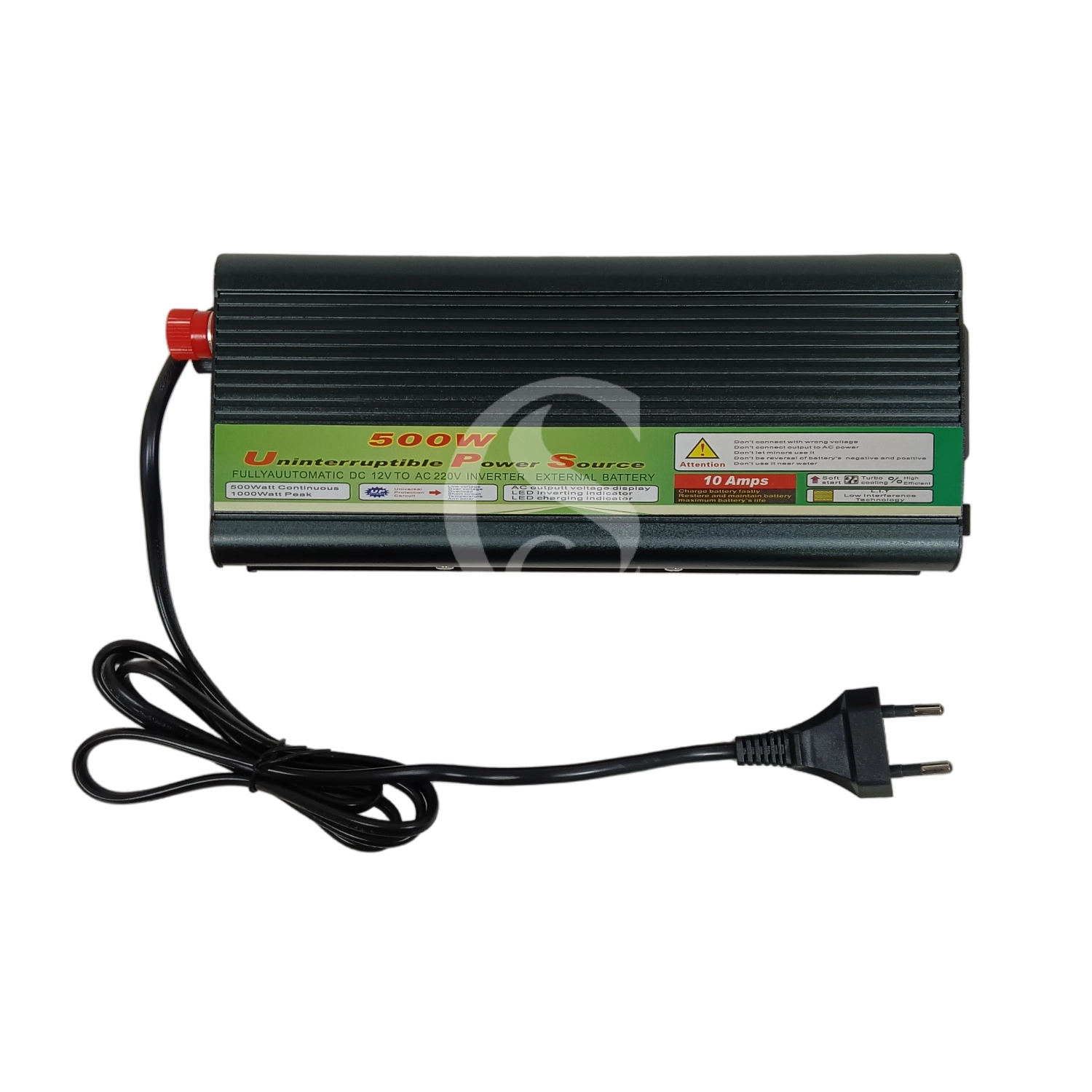
Congsin 500W DC to AC Modified Sine Wave Inverter 12V 220V Off Grid Power Inverter
Congsin 500W 12V to 220V inverter delivers reliable off-grid power with its modified sine wave design. This portable 500W DC to AC power inverter efficiently converts 12V DC to 220V AC, ideal for outdoor and emergency use. Trust Congsin for stable, portable energy solutions.
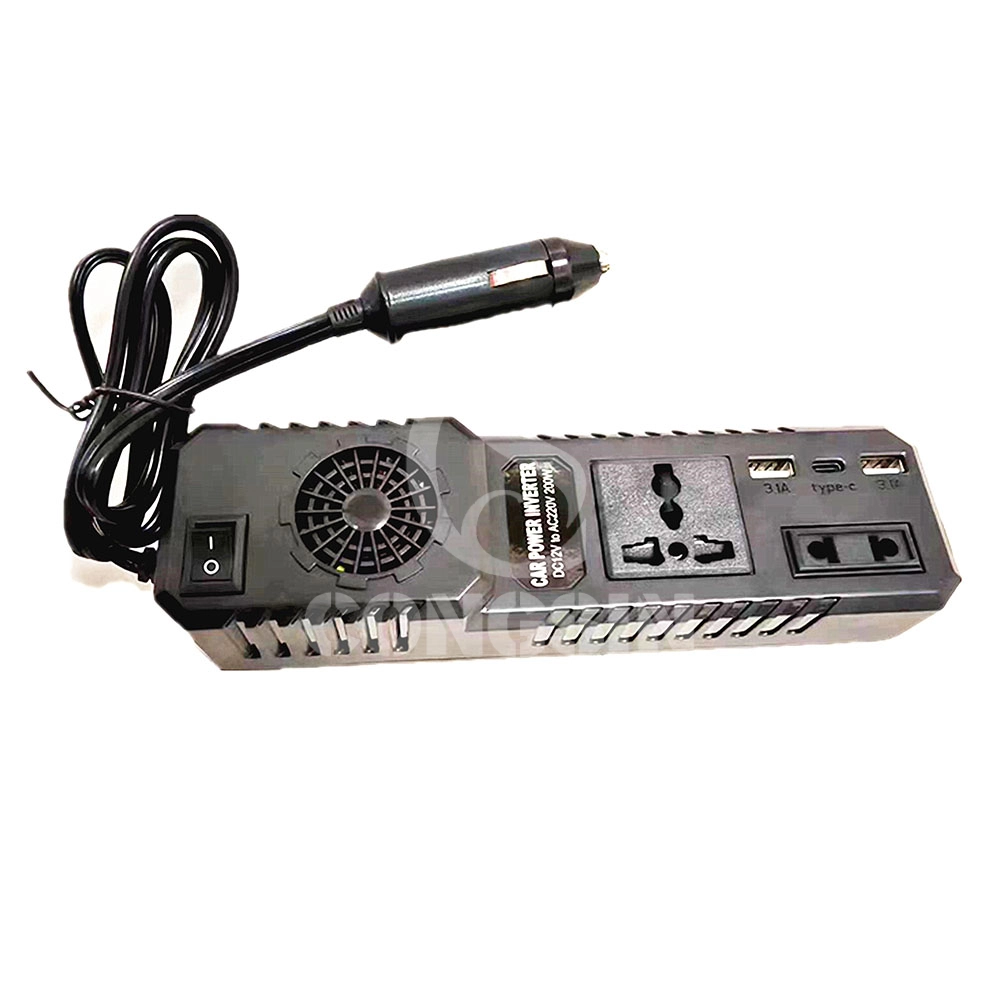
200W Modified Sine Wave Car Power Inverter, Dual Input DC12V/24V to AC220V with Type-C & Dual USB Ports
This 200W Modified Sine Wave Car Power Inverter is a compact and practical power conversion device designed for vehicle use. It supports dual input (DC12V/24V) and outputs AC220V, compatible with various electronic devices. Equipped with a Type-C port and dual 3.1A USB outputs, it can charge laptops, phones, cameras, drones, and other small electronics simultaneously—perfect for outdoor travel, emergency backup, and mobile work scenarios.
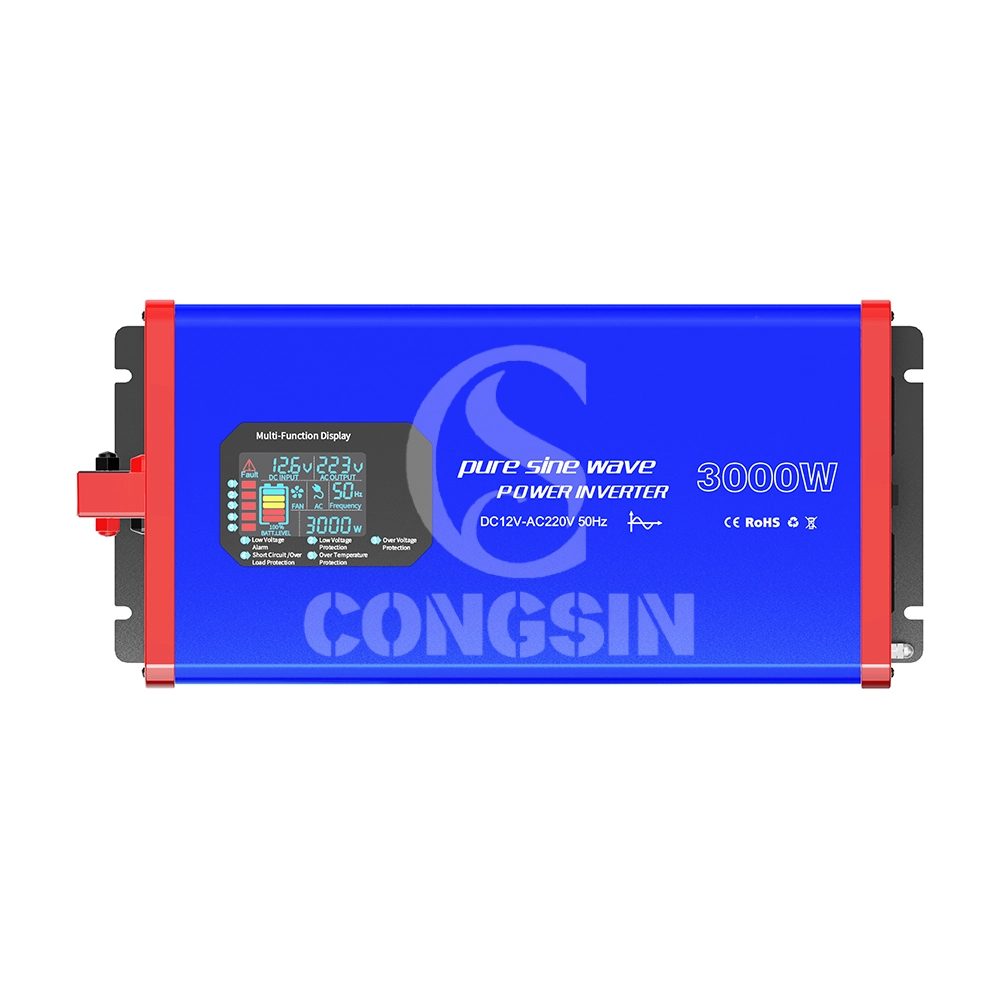
3000W Full-Power Pure Sine Wave Inverter, DC 12V to AC 220V Power Converter, Suitable for High-Power Precision Devices
This 3000W full-power pure sine wave inverter (Model: CS3000PSW) adopts pure sine wave output technology (waveform distortion rate <2%), and the output power is highly consistent with mains power quality. It can safely drive high-power precision loads such as air conditioners, refrigerators, medical instruments, and small industrial equipment, avoiding equipment malfunctions or shortened service life caused by unstable waveforms. The device supports DC 12V input (compatible with 10.5V-14.8V wide voltage), continuously outputs 3000W full power, and has a peak power of 6000W, easily coping with the instantaneous startup impact of high-power devices; it is equipped with 4 AC universal sockets (max current 16A) + 2 USB 3.0 fast-charging ports (22.5W per port) to meet the simultaneous power supply needs of multiple devices. Built-in six-fold safety protection (overload, overvoltage, undervoltage, short circuit, overtemperature, reverse connection), combined with dual intelligent silent cooling fans (noise ≤45dB), it achieves the triple advantages of "high power + high safety + low noise," suitable for home emergency, outdoor engineering, vehicle-mounted power supply, small industrial scenarios and other fields.
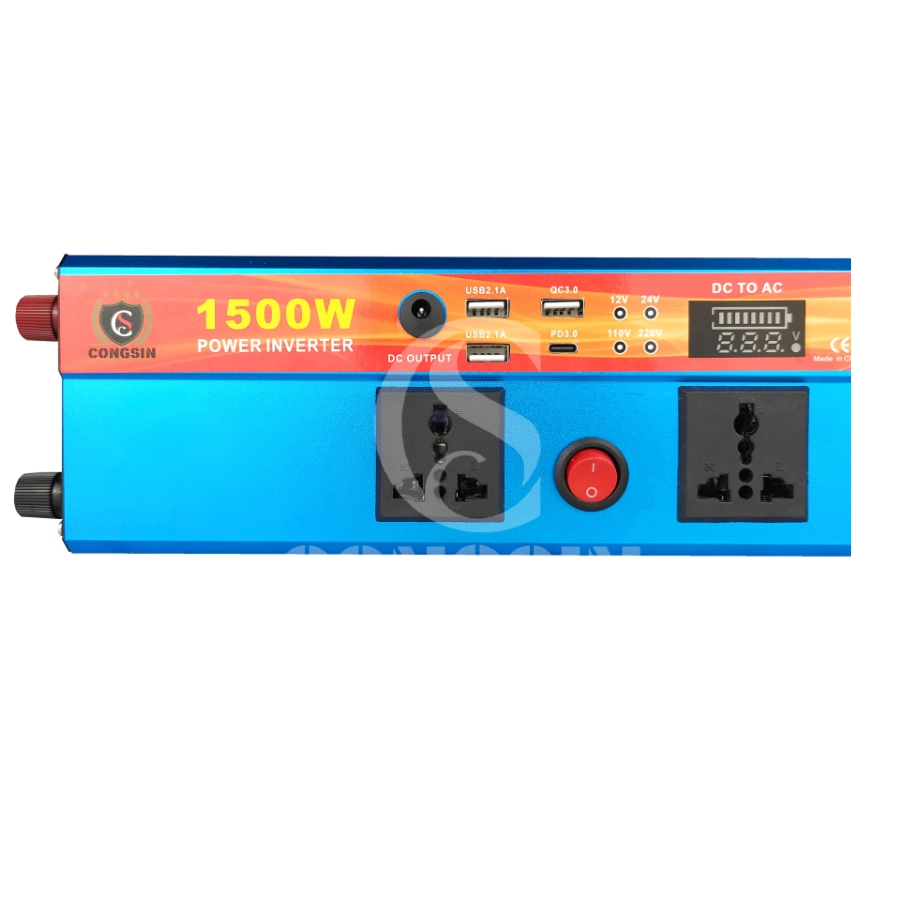
1500W Modified Sine Wave Inverter, DC 12V to AC 220V Power Inverter with LED Display, 3 USB Ports, 1 Type-C, 1 DC 12V Output & Two Universal Sockets
Our CS1000DDBC 1000W modified sine wave inverter is a professional power conversion device that converts DC 12V from batteries into AC 220V electricity. It is designed with user convenience in mind, featuring an LED display for real-time status monitoring, multiple charging ports (3 USB, 1 Type-C, 1 DC 12V) and two universal sockets to power a wide range of devices simultaneously. Its compact size (250×95×55mm) and lightweight design (NW: 0.84kg) make it easy to carry, ideal for outdoor activities, emergency home use, and on-the-go power needs.

CONGSIN is a trusted OEM factory for power inverters, solar charge controllers, and DC converters. Reliable solutions for global B2B buyers.
 High Quality
 7/24 Service
 Guaranteed Warranty
© 2025 Congsin. All Rights Reserved.